

The Google privacy conundrum: Why locking down your data is a hard choice - youngdosed1967
We detected a lot about AI and machine learning at the Google I/O developers conference keynote May 9, but in that location was unrivalled word that didn't make an show along a slip up: privacy. Dissimilar its heavyweight peers, Google didn't use its every year glare to announce any changes to the direction IT tracks and collects your data. If anything, it's doubling dejected happening data collection with things like the Google Duplex project, which uses your sound to make Subordinate-powered calls in the real-humanity.
While Facebook is trying to salvage its image in the backwash of the Cambridge Analytica scandal and Apple is positioning privacy American Samoa a "fundamental human right," Google continues to walk a fine line between protecting and profiling our data. Google makes No clandestine of the importance of information in its machine learning and artificial intelligence projects. Patc the tools are acquirable to limit information technology, IT doesn't on the dot advertise them either.
Unlike Apple, which puts a demanding roadblock between their customers and company, Google is upward-front about up how much data it uses. Nearly every product and feature Google demonstrated at I/O was the direct result of the way consumers already use its products. Barring a Cambridge Analytica-mouse-sized revelation that few foreign entity is misusing IT, data collection all told forms is not going to stop at Google. So unless you want to banish the explore giant from your liveliness entirely (in which case you probably shouldn't buy an Android telephone set), you're sledding to get to relinquish a certain degree of your privateness.
You may have gotten an email from Google high week about how IT is has "improved the fashio we draw our practices and how we explain the options you have to update, manage, export, and edit your data." That's due to the Europe's General Information Protection Regulation that goes into effect next week, and it's a wanted extension of its transparency. Just gain no mistake, Google International Relations and Security Network't making any substantial changes to its privacy practices. Rather, it's shifting the onus from the company to the exploiter, and handsome us a tough choice in the process.
Privacy Eastern Samoa a good and a choice
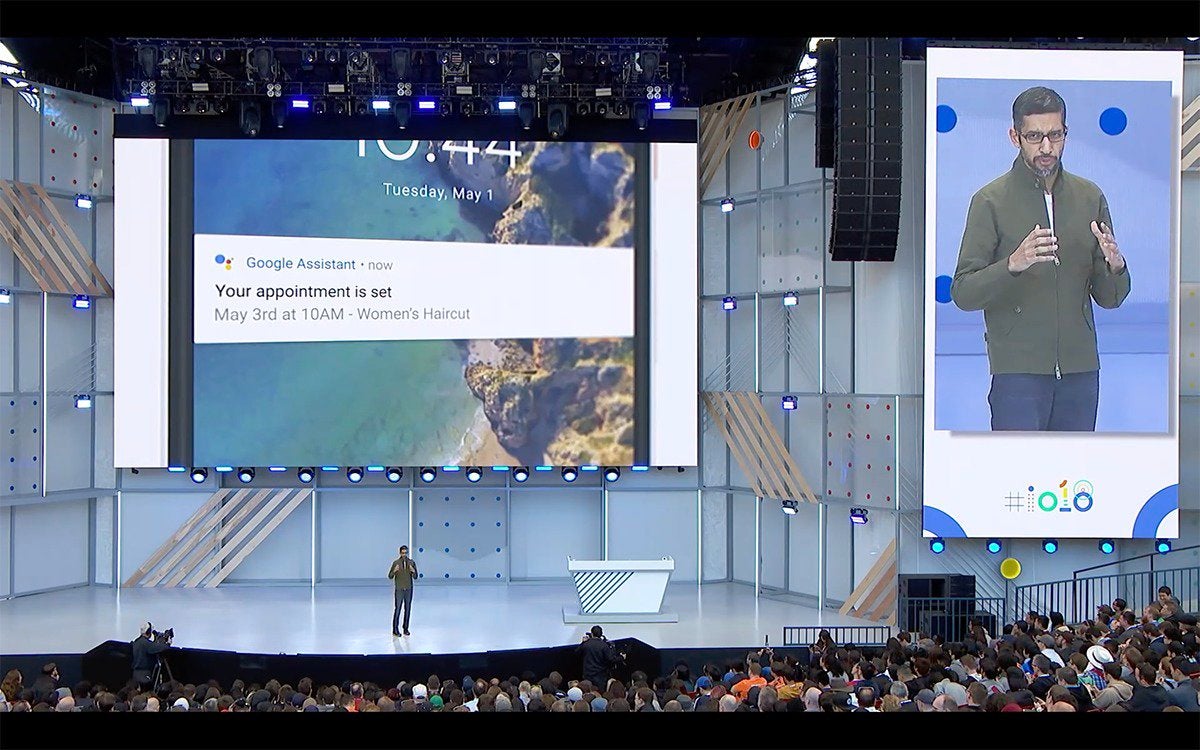
There were hearable gasps subsequently the Duplex demo during the I/O keynote, and for good reason. For the first gear meter in a non-written Hollywood setting, the crowd witnessed a fully realized Artificial intelligence bot calling a human clientele, interacting with a live person on the other end, and actually accomplishing a task, in this case making a haircut appointment.
 IDG
IDG Google Duplex is amazing because of the data that drives IT.
Had Google CEO Sundar Pichai not informed USA that it was Google Low-level making the call, barely anyone in the audience would have known. Help had actual speech patterns and verbal tics. It responded to questions asked past the person on the other end. IT exchanged pleasantries. In clipped, it had a real, human conversation. There's nothing even close to that level of AI coming out of Cupertino, and I doubt Apple's WWDC developer conference in June wish variety that.
Putting aside the potential for misuse, Duplex wouldn't be possible without the gobs of data Google collects from its users. But information technology also requires a loose concealment stance connected behalf of the user to operate. For incomparable, it needs position sharing sexy so IT can find a number to telephone dial. It needs access to your calendar to check for any conflicts. It's representing you in the veridical world. And most importantly, it's learning intimate details about your personal spirit, and smooth something as seemingly innocuous as how often you cut your pilus is valuable.
As it stands, these are license toggles that most users wouldn't believe turning away. They help lay down things like Maps and Google Helper work and so well, and of course they're not just limited to Android phones. Apple asks its users to turn on location sharing and permissions on iPhones as healthy, but the difference there is that most of the information doesn't leave your device. The parts that coif are and then encrypted and "noisy" that it's impossible to trace it binding to any one user. Google doesn't spend a penny the indistinguishable promise.
Eastern Samoa Bradypus tridactylus becomes more prevalent and autumnal, Sir Thomas More users are going to look for shipway to demarcation how much Google can see. But while they'll find surprisingly robust privacy options for your Android phone and Google account, but the price of flipping those toggles power be too alto.
Information-motivated apprais
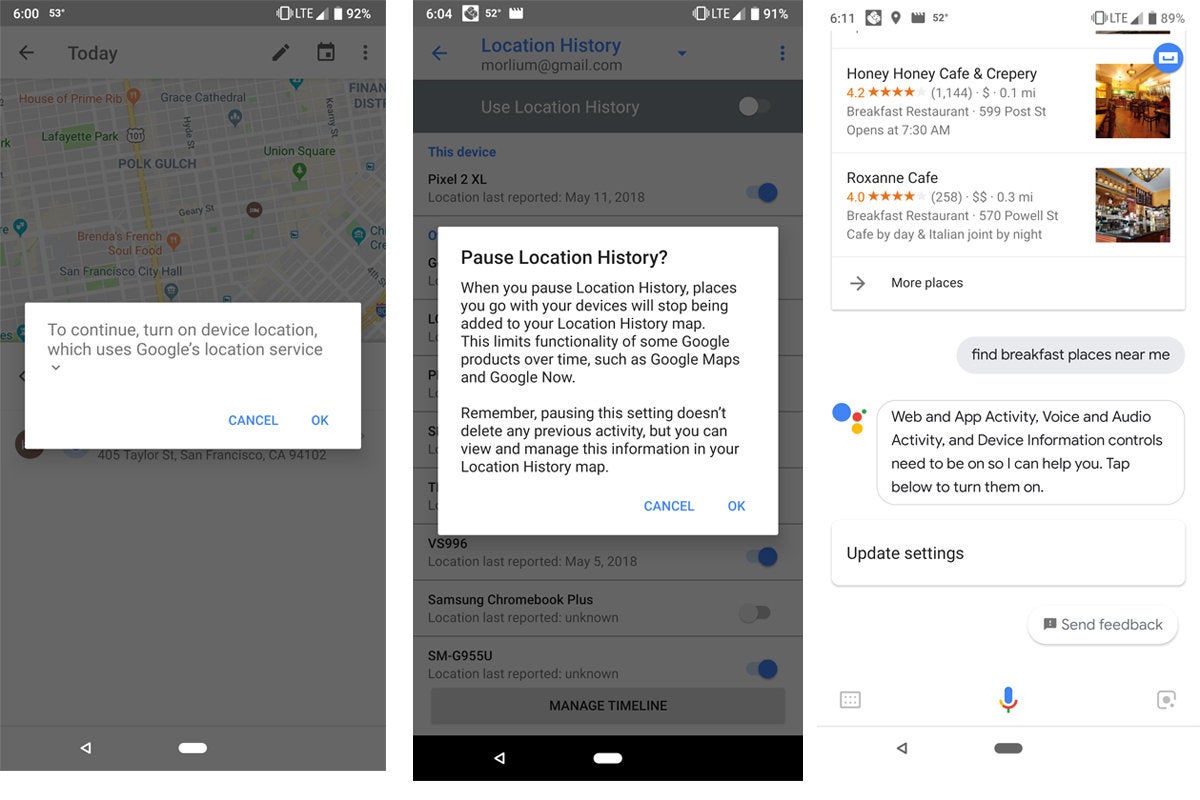
Because data collection is key to Google's AI efforts, things don't function nearly as comfortably without web and app activity and location chronicle turned on. In fact, some things don't work at all when you try to lock down your score. Turn off location services, and Maps doesn't launch properly (or at all). Flip off the Interpreter and Audio Natural process controls, and say goodbye to Helper.
 IDG
IDG Google's privacy controls come at a price.
So Google is giving US a same difficult choice. Where Apple has basically decided that privacy is Thomas More important than effectual AI for its billion-plus users, Google has taken a disparate tack. If you forego its best-in-class AI and car learning, you'll alter the live considerably. Get into't like Gmail scanning your emails to provide smart suggestions? Precise, don't turn over it on. Don't like personalized eating place recommendations? Fiddle with your location settings. But you won't be getting the unexcelled possible Google experience.
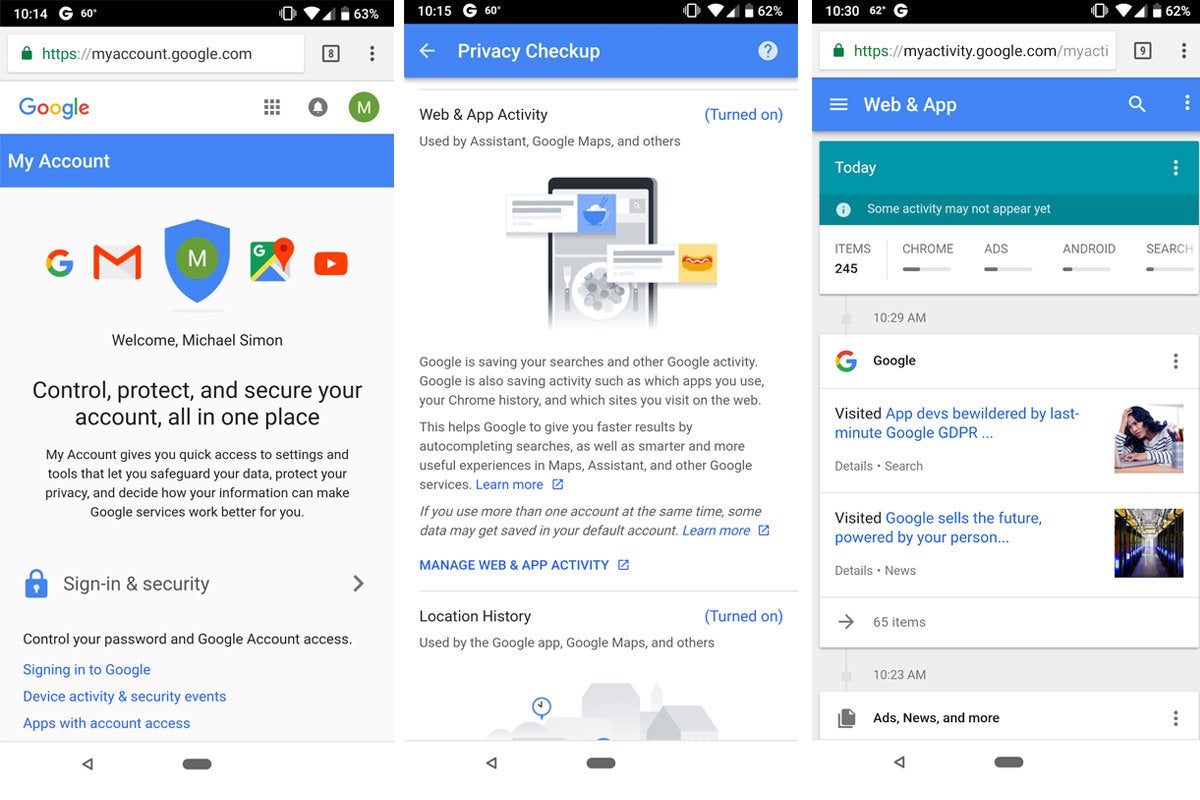
This is part of Google's strategic privacy child's play. The onus is happening the user to rule and implement their have privateness controls. Privacy on a Google device can buoy be as brawny as it is on an Orchard apple tree unitary, but Google sets up its model to steer users toward temporary privacy locks—things like incognito fashion on Chromium-plate and Do not disturb—rather than the nuclear toggles on your Activity page. By typing Localization History to Assistant, for lesson, Google is making the tasty to cut one of the most intrusive trackers nearly impossible to make.
A interrogative sentence of obligation
Google might not have mentioned privacy at its developers conference, but it's still a major part of its policy. For a large part of the show, the concept of Integer Wellbeing was touted arsenic a right smart to unplug from your sound. That's the main crux of Google's privacy stance: You decide your own level of involvement.
 IDG
IDG Google gives you lots of control over your account and data in your Natural process varlet.
Nowhere is that finer illustrated than in Android P. In addition to the Humanoid Dashboard that lets you set limits on app exercis and desaturates the screen when IT's prison term for bed, there's also a Lockdown selection. Lockdown protects your sound from snoopiness eyes by disabling Wise Lock, fingerprint unlocking, and curl-screen notifications. Information technology's an immoderate pick sure, but for Google, IT's no utmost than turning off location services or activity. For everything to work, you need to trust Google to keep your information safe, and Google needs to trustfulness its users to take in the straight choices with their privacy.
Apple has already successful that determination for you. With Google, the choice is up to you. But the decision might not be so easy.
Source: https://www.pcworld.com/article/401955/googles-apple-privacy.html
Posted by: youngdosed1967.blogspot.com
0 Response to "The Google privacy conundrum: Why locking down your data is a hard choice - youngdosed1967"
Post a Comment